Every actor, actress, singer, dancer, and everything in between needs an audition book. I mean we’re told auditioning is the job. Doesn’t it make sense to be as prepared as possible for anything you might walk into? Let me tell you everything you should have in your audition book and some tips for staying organized and even some peeks at my personal audition book!
First things first, I want to tackle the idea that all of your songs should be obscure, and the popular songs should never be used. Listen to me when I say this. no one sings a song like you do. No one sings Defying Gravity like you. No one sings Being Alive like you do. Sure, you maybe should avoid them if you can, but if you sound really good singing a song, sing the damn song!! I promise you the production teams would rather hear a song you know really well than a song you just learned, so play to your strengths!
Ok, let’s get into it:
Specifically, when talking about college auditions, most schools will ask for an up-tempo song and a ballad. Some schools will specify one needs to be golden age and the other needs to be contemporary, and even for schools that don’t specify, I think that’s a good rule to follow anyway. So, my suggestion is at least one up-tempo and one ballad for each of the following categories.
- Classical
I don’t think this category is entirely necessary, but if your training is more classical, it’s a good section to have. Depends more on what you will be auditioning for. Composers in this category can include Franz Schubert, Giuseppe Giordani, Gilbert and Sullivan, etc. In this category, I would also include Jazz standard and operetta style songs, again, both optional and depending on what you are auditioning for.
- Golden Age Musical Theater
This category is essential and one I use all the time. The Golden Age spans anything written from about 1940 to 1960. These tend to have more of a classical sound, but many modern renditions have given a more current groove, and you should be able to pick and choose which versions you would like to use. Composers from this era include Leonard Bernstein, Cole Porter, The Gershwins, Rodgers & Hammerstein, and many, many others. Some of my favorite shows from this period are The Music Man, Cinderella, West Side Story, and Gypsy.
- 1950s, ’60s, and ’70s Style
A category I was not expecting to need and ended up lacking was ’50s, ’60s, and ’70s style. Now this is technically 3 different categories, so I suggest finding one or two songs that are versatile in style, depending on what you need. For example, Joni Mitchell is technically ’60s, but some of her songs sound very ’70s style and can be used in both categories. The same goes with The Beatles. For the ‘50s, I have found a few songs from Patsy Cline’s library, as well as Doris Day. Of course, you should do your own research to find songs that fit your needs, but those are some suggestions to help you get started.
- Contemporary Musical Theater
This is probably the category you will have the most of already. This contains any musical theater from 1960 to today. My suggestion for this category is not to include any Sondheim or princess-style songs, as well as anything that is currently on Broadway, as those will have their own subcategories and will be needed for specific auditions. Instead, include ballads, character pieces, belty, and head voice songs to round out your book.
- Sondheim and Jason Robert Brown
Both composers you should avoid bringing into auditions unless specifically asked to, as they tend to write music that is way harder for an accompanist to sight-read on the spot. Some accompanists may be able to tackle it, but you never know what you’ll walk into, so it’s better to be safe than have a bad audition. You should use a Sondheim song when auditioning for a Sondheim show; the same applies to Jason Robert Brown. Both composers have a large library to choose from, so do some digging and find some fun songs!!
- Princess Pieces
This should only be necessary if you are female-presenting or plan on auditioning for princess-style roles or if you just like singing princess songs. There’s a lot of princess content to choose from (thank you Disney), but generally, I try to select songs from the stage shows before choosing from the movies. However, there are a lot of great songs in the movies that aren’t in the shows, and vice versa, so honestly, just use your best judgment and pick a song that’s right for you.
- Pop/Rock
I think this is often a neglected category, but these have been some of the most fun songs I have ever sung. It can be a little bit difficult to find good pop songs that are versatile and fit your voice, but this is such a broad category that you can find some really good songs. My favorite cheat code? Glee. Don’t tell anyone.
- Country/Folk
Listen, if you play your cards right, you don’t have to include this as its own category. There are some really good ’50s, ’60s, ’70s, and pop songs that can count for country or folk. But this category is something you should have just to make sure that box is checked.
- Something Obscure
This is your chance to pull out that song that no one has ever heard of. Personally, my obscure song is from a musical from the 2000s that no one has ever heard of, but I also have a friend whose obscure song is O’Malley the Alley Cat. Find something fun! Sing something from the Muppets, sing that song that makes you laugh every time you hear it. Have fun!!
- Something Currently on Broadway
Songs from this category should only be used when specifically asked. These will probably be used more in professional auditions, and they generally should be avoided due to the popularity factor. However, use my advice in the beginning here as well. Sing a song if it sounds good. These will also need to be changed out every year or so due to the high turnover on Broadway.
Organizational Tips:
My book is organized in the order above, with each section marked with dividers. I have created a title page, so you don’t have to flip through the book to see what songs you have. It should look something like this:
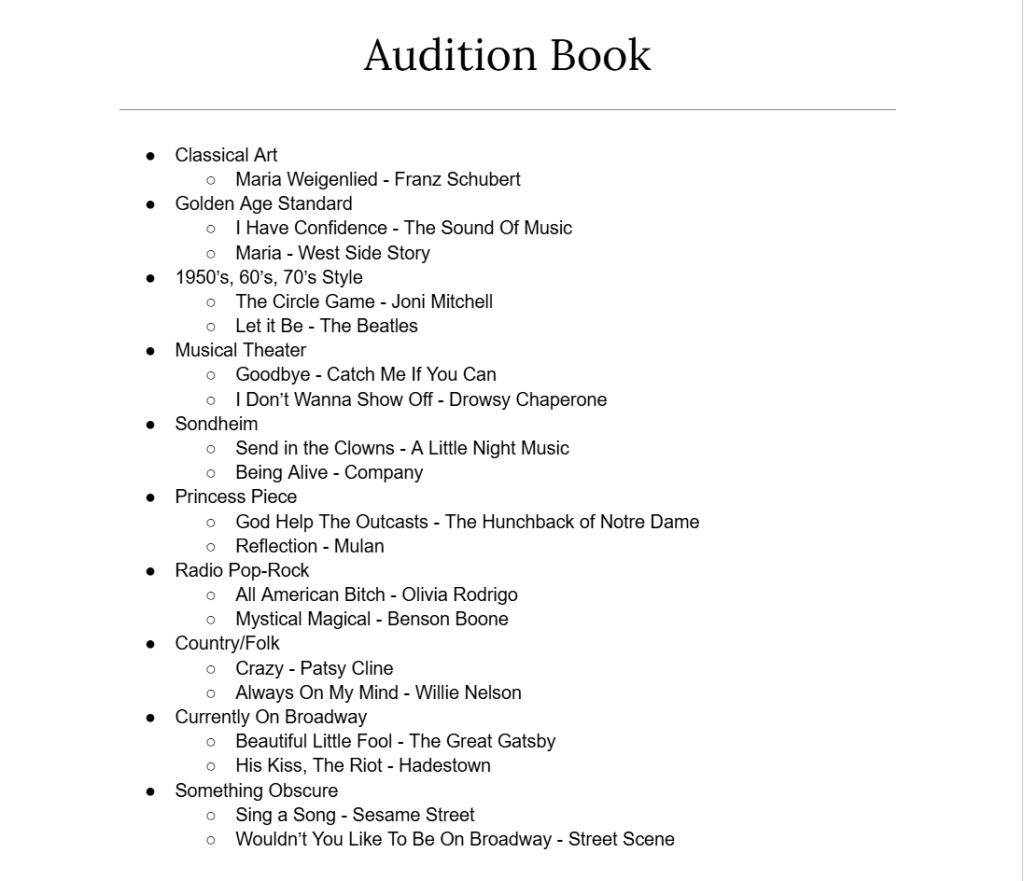
These are some examples of songs to help get you started.
You should keep all of your music in a binder (your book, silly). Inside, you should keep extra copies of your resume and an 8×10 copy of your headshot to put in the front pocket of your binder.
Other things you need to include
- Sheet Protectors
- Dividers
- Sticky Notes or an Expo marker to mark your cuts
I had a lot of fun putting together my book, and I hope you do too. If you need help finding sheet music, I’m more than happy to compile a list of resources for you! I love you all!!!
 Addie's Daydreams